Earls Court LodgeNo. 2765

Documented history

Warranted 1899. Still working in London.

Earls Court Lodge No. 2765 was warranted on 5 June 1899 and consecrated on 7 July at the Royal Palace Hotel, Kensington.

In brief

The lodge developed rapidly: by March 1900 a reported meeting drew more than fifty members and visitors and included several ceremonies. Early membership included military figures, medical professionals, and the exhibition impresario Imre Kiralfy. Founder Charles G. Hatt later attained Grand Lodge office. Colonel Sir William Watts, who served in South Africa during the Boer War, became Master in 1903. The lodge then met at a succession of London venues — the Trocadero, Criterion, Rembrandt Hotel and Hurlingham Club — before moving to the West London Masonic Centre in 1988. It received Hall Stone recognition during the interwar Masonic memorial appeal.

1899

Foundation

Lane’s Masonic Records — the historical lodge register published by the University of Sheffield’s Digital Humanities Institute with the Museum of Freemasonry — records the name Earls Court Lodge, number 2765, warrant issued 5 June 1899, consecrated 7 July 1899, original meeting place the Royal Palace Hotel, Kensington. That is the strongest independent evidence for the lodge’s formal origin.

One documented founder was Charles G. Hatt. A 1904 profile states that Hatt had been initiated into Dalhousie Lodge No. 865 in 1887, joined Kensington Lodge No. 1767 in 1892, and helped found Earls Court Lodge in 1899. He later occupied its Master’s chair. The same source identifies him as founder and first “Z” — First Principal — of Earl’s Court Royal Arch Chapter No. 2765, so a Chapter connected to the lodge was established very early.
Lineage

From Saint Lukes to Earls Court

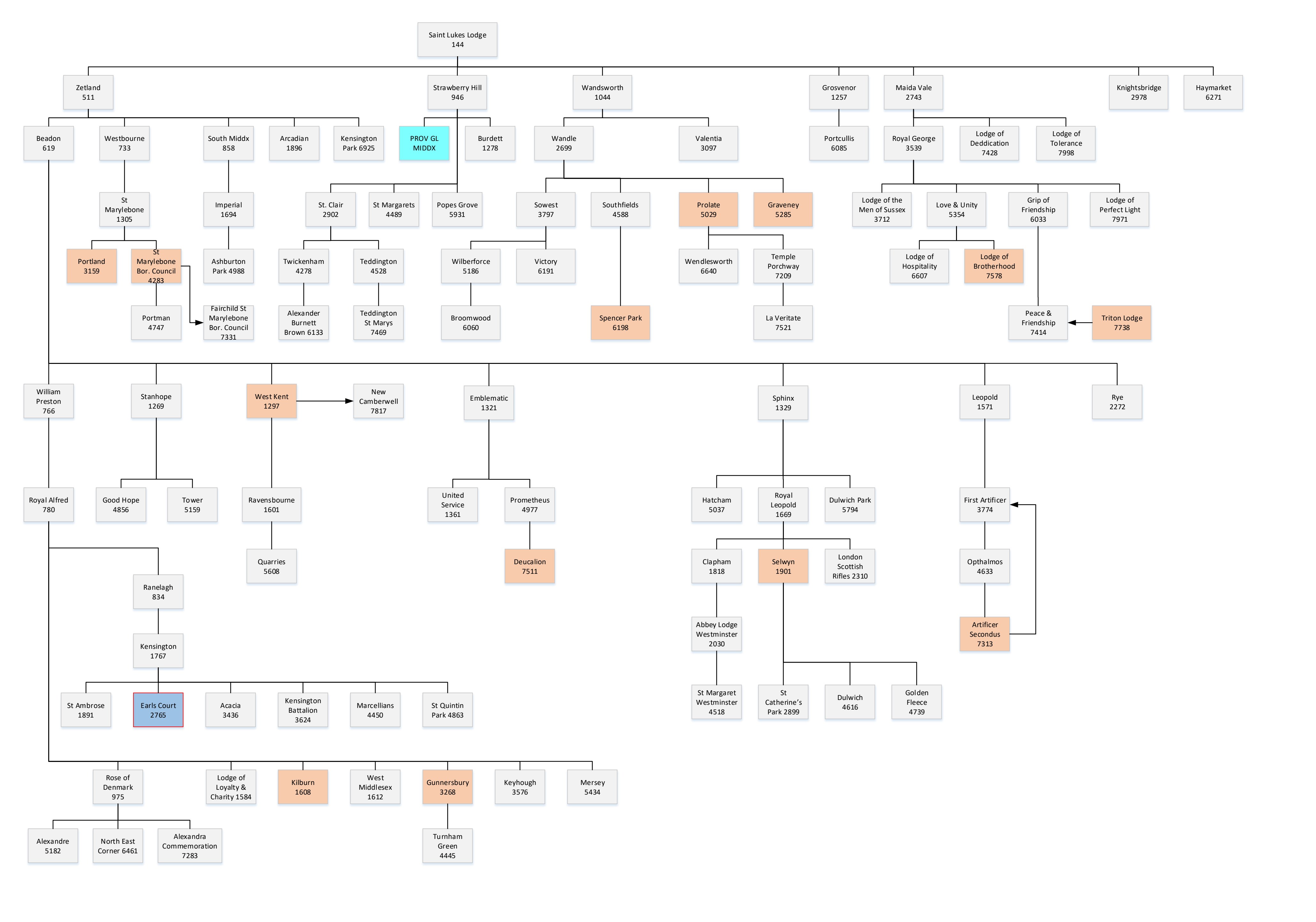
The lodge family tree traces a line of London lodges from Saint Lukes Lodge No. 144. Earls Court sits on the Kensington Lodge No. 1767 branch — the same lodge named in our petition as sponsor. Charles G. Hatt had joined Kensington in 1892, seven years before he helped found this lodge.

  1. No. 144

    Saint Lukes Lodge

  2. No. 766

    William Preston

  3. No. 780

    Royal Alfred

  4. No. 834

    Ranelagh

  5. No. 1767 · Named as our sponsoring lodge

    Kensington

  6. No. 2765

    Earls Court

Daughter lodges of Kensington No. 1767

Family tree of lodges descending from Saint Lukes Lodge No. 144, with Earls Court Lodge No. 2765 outlined on the Kensington branch
Scroll to explore the full chart. Earls Court No. 2765 is outlined on the left of the Kensington branch.Download the PDF

1899–1900

Rapid early growth

A contemporary report published on 31 March 1900 describes the lodge as one of the newest additions to West London Freemasonry, already “flourishing”, attracting more than 50 members and visitors, and meeting at the Royal Palace Hotel. The gathering of 14 March 1900 was the lodge’s fifth meeting — an active first eight months.

Four candidates — E. A. Warton, F. Stovold, S. H. Procter and S. R. Rogers — were initiated at that single meeting. Thomas M. Ross was raised as a Master Mason and Frederick Fewell was passed as a Fellow Craft. The number of ceremonies in one evening indicates substantial early recruitment.

Officers, 14 March 1900

  • Lt-Col. G. E. E. BluntWorshipful Master
  • J. WorthSenior Warden
  • Lt-Col. William WattsJunior Warden (in South Africa)
  • Imre KiralfyActing Junior Warden
  • F. LangfordImmediate Past Master
  • J. CoxTreasurer
  • J. W. FaceySecretary
  • Charles G. HattJunior Deacon
  • W. S. LyonDirector of Ceremonies
  • F. PackerOrganist

People

Kiralfy, and the war

Imre Kiralfy was the prominent exhibition impresario associated with spectacular productions in late-Victorian London, including Earl’s Court. The March 1900 report records him substituting for William Watts as Junior Warden. His presence supports a genuine connection between the early lodge and the commercial and theatrical world around Earl’s Court. Independent sources establish that he was an officer or prominent early member; they do not, by themselves, prove that he conceived or formally founded the lodge.

That same meeting sits squarely in the Second Boer War. Lieutenant-Colonel William Watts, Junior Warden, was absent with his regiment in South Africa. The lodge contributed ten guineas to a Masonic fund supporting refugees connected with the conflict — early evidence of both military connections and charity. UGLE’s biography confirms Watts was associated with Earls Court Lodge and later served as Worshipful Master in 1903.

1901

Lodge of Instruction

A June 1901 issue of The Freemason’s Chronicle reports an Earl’s Court Lodge gathering at the Greyhound Hotel, Kensington Square, with K. von Donat as Master and J. Worth as Preceptor. The word “Preceptor” indicates Lodge of Instruction rather than a regular warranted meeting. It does not contradict the Royal Palace Hotel as the lodge’s formal home. Structured ritual practice was established very early — a habit the lodge still keeps on Monday evenings.

Wider recognition followed quickly. In 1902 a profile identifies surgeon R. J. Maitland Coffin as a member and a founder of the Chapter, also associated with the St John Ambulance Brigade. In 1904 Charles G. Hatt was appointed Assistant Grand Pursuivant. Within five years of foundation, a leading founder had attained national Masonic office.

Homes

Not tied to one building

Lane’s register traces a geographical journey through major London hospitality venues before the lodge settled at Ealing. That itinerant pattern was common among London lodges, which often met in hotels, restaurants and clubs rather than owning a hall.

  1. 1899Royal Palace Hotel, Kensington
  2. 1906Trocadero Restaurant, Shaftesbury Avenue
  3. 1922Criterion, Piccadilly
  4. 1930Rembrandt Hotel, Thurloe Place
  5. 1974Hurlingham Club, Fulham
  6. 1988West London Masonic Centre, Ealing — still our home.

1921–1933

Hall Stone Lodge

Lane’s record gives the lodge a Hall Stone Medal date of 1921–1933. Hall Stone recognition belongs to the interwar Masonic fundraising programme for the new Freemasons’ Hall as a memorial to Freemasons who died in the First World War. The lodge therefore qualified during the appeal. The individual donation, date of qualification, and names of contributors are not in the published register and would need the Hall Stone rolls or the lodge minutes.

After 1945

A family lodge, then a daughter

An independent Provincial Grand Lodge archive records Dr Frederick “Fred” Day: initiated into his father’s lodge, Earl’s Court No. 2765, on 13 March 1947; Master in 1959; later a founder and first secretary of Featherstone Lodge No. 7851 in 1962. That is a clear example of intergenerational membership, and of Earls Court supplying experienced brethren to newer lodges after the Second World War.

Members

Names the sources will support

Some names in OCR-derived periodicals may contain transcription errors. For example “Halt” in one meeting report is probably Hatt.

Lodge tradition

What the lodge itself has always told

The lodge’s own history records a petition dated 19 May 1899, sponsored by the Master and Wardens of Kensington Lodge No. 1767 — James W. Facey, Frank Norman and Lewis Beale. It says the Greyhound Hotel was entered first, then replaced by the Royal Palace Hotel, and that Grand Lodge omitted the word “Royal” from the proposed name. The family tree above places Earls Court on that Kensington branch. Independent online sources have not yet confirmed the complete founder list; those details belong in the lodge file at the Museum of Freemasonry.

The name comes from the old Manor of Earls Court. Lodge tradition also places early conversation in the Welcome Club of the Earls Court Exhibition. That is plausible given Kiralfy’s membership, but it remains tradition until the minutes or petition say so.

Consecration banquet

Preserved in the lodge history

  • Queue de Boeuf
  • Petit Marmite
  • Saumon, Sauce Hollandaise
  • Blanchaille Frite
  • Pâté de Pigeon à l’Anglaise
  • Caisse de Ris de Veau à la Régence
  • Baron d’Agneau Rôti, Sauce Menthe
  • Caneton Rôti aux Petits Pois
  • Tartes aux Fraises
  • Bombe Nesselrode

Sources

What is known, and what is not

Still to be checked in the lodge file, warrant, petitions, annual returns, Hall Stone registers and minute books: the complete list of founders, the full consecration programme, succession of Masters, membership numbers, war service and casualties, the later history of the Chapter, activity in both world wars, and whether 1999 was marked as a centenary. The Museum of Freemasonry is the strongest next stop.